Your cart is empty
Looks like you haven't added anything to your cart yet




Plastic-Free Brushes Underpinned by Ethical Practices
 We all know the importance of finding more sustainable, plastic-free alternatives when creating an eco-friendly lifestyle. When we founded LoofCo in 2017, our mission was to create products that offer simple, affordable switches while helping to reduce household plastic use and waste — including the microplastic particles released by plastic washing-up scourers, sponges, and brushes.
But what was equally important to us was ensuring that we worked with our suppliers on an ethical, collaborative, respectful, and fair-trade basis — using natural, vegan, plant-based materials and respecting the traditional methods and practices of the communities who make them. In our view, this is what makes a product truly sustainable: safe for the planet and fair to all its people.
Cottage Industry Production
LoofCo is a range of 39 plastic-free pads, brushes, cloths, and soaps for washing-up, household cleaning, and bodycare. This includes a coconut husk scraper and 8 coconut coir-based brushes, all made in small batches in rural Sri Lanka.
Sri Lanka has an abundance of coconut palm trees that yield coconuts every three months. Coconut coir fibre and husk are by-products from coconuts processed for the food and oil industry. The coir fibre is extracted from the matured brown coconut husk — it has strong twist resistance, remains stiff when wet, and is completely natural, renewable, and 100% biodegradable. Coconut husk, meanwhile, makes a superb traditional pan scraper. Excess husks and fibre are often burned if not put to use, so LoofCo products help to reduce this practice in a small but meaningful way.
Our brushes and scraper are made in rural areas of Sri Lanka to our own designs, inspired by tradition and proven over generations. They are not mass-produced — they are skilfully handmade by individual artisans under a unique social enterprise-based cottage industry model. In areas where employment choices may be limited, a village production centre provides the necessary equipment — twisting machines, wire cutters, weighing scales — and the production centre leader employs workers from the local community on a flexible basis.
At these local centres, fibres are cut and twisted around wire into ‘rods’. Depending on the brush design, the rods are then trimmed, bent, and fashioned to the correct shape, quality checked, and packed. Rubberwood handles — made from plantation trees that no longer yield latex — are added at this stage. Some finishing work takes place at workers’ homes. The carving of the Washing-Up Scraper is carried out by trained artisans in their own home workshops.
Fairly Traded
LoofCo brushes are fairly traded, with the 10 principles of the World Fair Trade Organization (WFTO) adhered to throughout our supply chain. Workers benefit from higher wages than other local employment, flexible working hours that fit around family commitments such as childcare and school runs, and a genuine sense of community — including trips, pilgrimages, and gifts of food provisions around holiday times.
This spirit of tradition, community, and fair working practices is central to what LoofCo stands for — and it’s something we’re genuinely proud of.
A Brush with Nature
These are the brushes and scraper made for you in Sri Lanka — and beyond. From the kitchen to the garden, bathroom to the beach, each one is effective, affordable, and long-lasting:
- LoofCo Washing-Up Brush — a handheld brush for scrubbing crockery, cutlery, pans, and woks. Designed to fit into cups to remove tea stains.
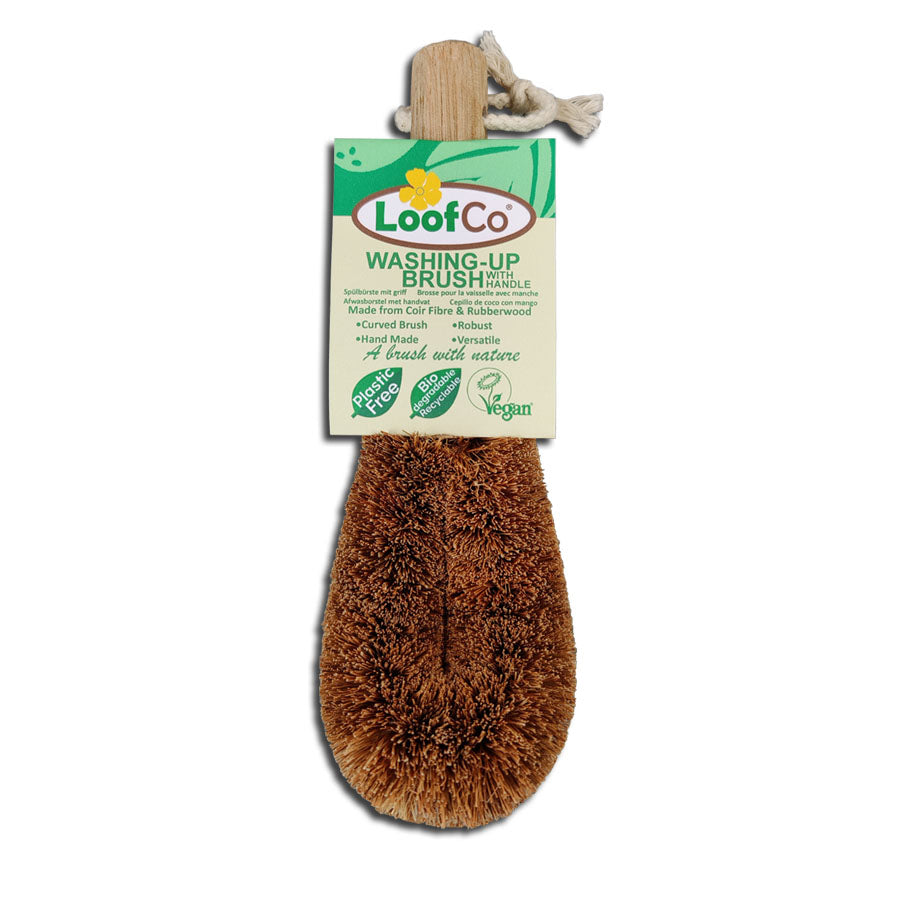
- LoofCo Washing-Up Brush with Handle — a curved brush head and rubberwood handle, perfect for everyday washing-up.
- LoofCo Bottle Brush — a long brush for cleaning jars, tins, dishwasher filters, and juicer blades.
- LoofCo Milk Bottle Brush — perfectly designed for cleaning glass milk bottles, made from natural coir fibre.
- LoofCo Wide Bottle Brush — ideal for cleaning vases, cafétières, blenders, and wide-necked bottles.
- LoofCo Water Bottle Brush — designed for easy, thorough cleaning of reusable drinks bottles.
- LoofCo Non-Stick Pan Brush — a natural sisal brush safe for use on non-stick coatings.
- LoofCo Scrubbing Brush — a generous handheld brush for garden and household cleaning.
- LoofCo Mini Scrub Brush — a small handheld brush for scrubbing sinks, chopping boards, and getting into corners. Great for travel and camping.
- LoofCo Dust Brush — a natural coir and rubberwood sweeping brush for dusting and light sweeping.
- LoofCo Gardener’s Brush — a robust coir brush with rubberwood handle for cleaning pots, tools, lawnmower blades, and more.
- LoofCo Seaside Brush — a natural brush for removing sand from skin, towels, and beach equipment.
- LoofCo Wheelie Bin Brush — a long-handled natural coir brush for cleaning outdoor bins.
- LoofCo Household Bin Brush — a natural coir brush for cleaning indoor bins and pots.
- LoofCo Dry Body Brush — a natural jute brush for dry body brushing and lymphatic drainage massage.
- LoofCo Shower Puff — a natural sisal body exfoliator, a plastic-free alternative to synthetic shower puffs.
- LoofCo Back Brush — a natural sisal exfoliating shower brush for hard-to-reach areas.
- LoofCo Washing-Up Scraper — an ingenious coconut husk tool that lifts baked-on food residue without scratching.
Happy, healthy cleaning!
— Lois Clark, NatBrands Ltd.
- Choosing a selection results in a full page refresh.
